Exhibition Live Page
Weaving the Islands - Four Hong Kong Artists on Noko Island
Artist Cafe Fukuoka
Curatorial Statement
This exhibition is a project of memory and dialogue by four Hong Kong-based artists who participated in a residency on Noko Island, Fukuoka. Against the shared backdrop of being "islands," the artists reweave narratives through diverse lenses: food, gifts, labor, and space. The late woman who once planted and nurtured citrus trees in the garden on Noko Island, and the late mother of Shirley Tse, who loved her peach trees in far-off America. This project reflects on the act of "nurturing" entrusted to the soil by these two Asian women. The act of wrapping a Noko natsumikan (summer orange) in American citrus wrapping paper illustrates the overlap of time and the enduring bond between mother and daughter—transcending geographical boundaries, life, and death. Wong Ka Ying distributes handmade uchiwa fans to the islanders as gifts; Phoebe Man gives form to memories of food on Noko Island; and Sara Tse unravels a decade of memories associated with a former elementary school. The aesthetics they have discovered within fragments of the everyday—oranges, insects, and fans—quietly bridge the islands of Fukuoka and Hong Kong, as well as the past and present, delivering new seeds of dialogue to us all.
Works

Wong Ka Ying(Hong Kong, b. 1990)
My Sweet Belgium, 2026
Color printed paperboxes, resin installation
Dimensions Variable
The resin seashell chocolate of the work revisits a cheap seashell-shaped European chocolate that many Hong Kongers born before 2000 remember: visually charming, but oddly bad in taste. By recasting it in resin, the work freezes an absurd attachment to colonial fantasies and white good taste, exposing how desire is manufactured through branding, origin myths, and the distant image of the sea. These fake confections become small monuments to fake dreams — sweet on the surface, hollow on the tongue — asking how collective memory digests the aftertaste of empire, while only the empty package boxes are left behind.

Wong Ka Ying(Hong Kong, b. 1990)
Breeze that connects us all, 2025
Hand drawn bamboo paper fan, A5 photos Installation
Dimensions Variable
During my residency on Nokonoshima Island, I created a series of hand drawn paper fans as community gifts, using food as inspiration, mediator, and cultural vessel. Inspired by the self-made Nokonoshima Island Food Map created by local islanders, the project views food — including oranges, vegetables, and local produce — as a carrier of memories, community design, and shared experiences. Paper fans, a traditional Japanese and pan-Asian object, serve multiple roles: as practical cooling tools, promotional items, and meaningful gifts. Before leaving the island, I presented hand painted fans to major restaurants including 防人 (Mrs. Kubota), Noko Burger, Noco Nico Café, Zakko, and the ramen shop. Some of these fans are now actively used or proudly displayed by the owners. In the spirit of gift economy and Buddhism, where helping others is helping yourself, these fans embody the idea that together we are "many." Light and portable, they carry breezes, conversations, and human connections, turning fleeting encounters into lasting community bonds.

Phoebe Man
8 Tastes of Longing, 2024
Animation
5'40"
Food is a source of happiness for many people and can instantly satisfy both physical and mental needs. When we leave home and travel to a different place, we naturally compare the similarities and differences in the food between the two locations. This comparison enhances our understanding of both our home and the new environment, making us more aware of the distinct characteristics of each place and our identity. Man used images and text to express her food memories from Taiwan and Hong Kong. Additionally, audiences can use food coloring sheets to share their memories, feelings, and imaginations about food during the exhibition.

Phoebe Man
The Tastes of Longing: Fukuoka, 2026
Workshop / Participatory art
Dimensions Variable
Viewers can use the food coloring sheets to share their memories, feelings, and imaginations about the food of Fukuoka. What you draw could be used for the artist's work of art later.

Sara Tse
Woven Campus, 2026
Classroom floor monoprint, plant coloured fabric collage, embroidered linen,interview records of school principal, teacher and alumni, plant
Dimensions variable
Commissioned by CHAT (Centre for Heritage, Arts and Textile), Hong Kong
Native Cultivated Invasive Introduced Not reported The factories near the school are gradually being transformed into offices and commercial buildings, with artists even moving in to set up studios. Since 2015, Sara Tse has relocated her studio near the school, focusing on researching the school's history and actively collecting and preserving related documents and artefacts. Before the school was demolished, she returned to the campus to create several works, including transforming the school's leaves into ceramic pieces ("Leaves Falling as Songs Coming to My Mind," 2019), making rubbings of stone tablets, and documenting the school's memorial hall through a series of cyanotype works and six video pieces ("My School," 2022). Before the school's demolition in 2023, she invited teachers and alumni back to the fourth-grade classroom to make the floor prints. In 2025, the Centre for Heritage, Arts and Textiles (CHAT), housed in the former cotton-spinning factory of Nan Fung Textiles in Tsuen Wan, Hong Kong, invited Sara to lead a year-long community project Seed to Textile. She engaged alumni and teachers from various generations to conduct oral history interviews. Together with alumni and the public, they cultivated plants that once thrived at the school, extracted natural dyes to create a Maps of Plant Growth and Distribution, and dyed fabrics and yarn, embroidering 20 types of plants onto textiles. The naturally dyed materials and archival photographs were woven onto branches collected from local trees of Hong Kong. Sara also created molds from old candy jars found at the school's snack counter, inviting alumni and the public to mix the school's soil with clay to craft ceramic jars. In January, these woven branches were placed in the ceramic jars and displayed on the classroom floor's prints. This installation encapsulates their year-long co-learning journey, celebrating intergenerational bonds fostered through socially engaged art. The project culminated in a performance where alumni, teachers, and local elementary students sang songs in different languages with the same melody, wearing naturally dyed scarves embroidered by 2,300 CHAT's visitors. This artistic installation serves as a metaphor, suggesting that songs are like seeds transplanted to different places, carrying forward the community's strength. Photo: According to a plaque at the Kwai Choi Memorial Hall, the Nan Fung Textiles Factory was one of the sponsoring companies for the school's expansion donations.

Sara Tse
On the way home, 2022
Single-channel video
15'17"
Sara takes her children along the path she once walked to school in her childhood. From the school's hill, they stroll down the streets lined with factories back to the village, where her childhood home has long been demolished and replaced by unfamiliar houses. The hometown exists not as a physical place, but only in memories. She and her children embark on the way home again, which is their current home.

Sara Tse
Nokoshima’s summer light, Shadows of Hong Kong in my friends' sight, 2025
Cyanotype on papers
9.5 x 13.5 cm x 15 pieces
Hong Kong expatriates scattered across the globe are connected via the internet, resonating with images of Hong Kong and ultimately responding with traditional physical letters. I collect old photographs of Hong Kong taken by friends from social media, convert them into negatives, and bring them to Noko Island. When I use the sunlight of Noko to create cyanotypes of the photos, the images of Hong Kong emerge in those unfamiliar environments, creating a temporal and spatial interweaving, much like transplanting native plants to a foreign land. Some of the cyanotype works have been sent as postcards to the friends who provided the photos.

Shirley Tse
Itoshima Sun Painted My Skin, 2026
Giclée print
61cm x 91.4cm

Shirley Tse
Itoshima Sun Painted My Skin X-ray, 2026
Giclée print
61cm x 91.4cm

Shirley Tse
Noko Summer Orange Dressed in Vintage Sunkist, 2026
Giclée print
76.2cm x 101.6cm
"Orange and Peach" My research project is called "Orange and Peach." I am bringing together histories of cultivation of fruit trees (especially orange trees) in Japan and California and weave them with my personal story of a peach tree that was gifted by my mother, and the parallel story of citrus trees planted by Yuka Yugetsu's original owner. Migration, care, farm labor, and legacy are the main themes. During our residency at Yuka Yugetsu in July 2025, I initiated contact with farmers and a chef that uses local fruits. I observed what orange farms and berry farms are like on Noko Island. I made a few "photo-performances": I wrapped a Noko Summer Orange with a vintage 1920s California Sunkist brand orange wrapper printed with an orange cream puff recipe, thereby merging the two histories. I intended to bring home some orange peels to further develop this work but realized I cannot bring them across the border into California because they pose the threat of diseases to the California orange farming industry. During an outing studying nature in Itoshima, I got a severe sunburn from the hot July sun. As my skin was peeling, I thought of the orange peel. I created yet another photo-performance by photographing my skin fragments on a photo lightbox. It is titled "Itoshima Sun Painted My Skin." Orange cultivation was brought to California in 1769 by Spanish missionaries. Chinese farm laborers were first hired until the Chinese Exclusion Act in 1882. They were replaced by Japanese farmers until WWII. Many Japanese farmers, who by then owned their own citrus farms, lost their farms when forced into internment camps. I imagine the oranges telling their own stories, and not in an easy way.

Shirley Tse
Letters from Orange, 2026
Giclée print
68.6cm x 101.6cm

Shirley Tse
Letters from Orange: immigrant labor, 2026
Giclée print
68.6cm x 101.6cm

Shirley Tse
Letters from Orange: Sunkist, 2026
Giclée print
68.6cm x 101.6cm

Shirley Tse
Letters from Orange: Peach Tree, 2026
Giclée print
68.6cm x 101.6cm

Phoebe Man
Nokonoshima Journal: Summer Oranges, 2026
Digital colour print
21cm x 30cm
The summer oranges on Noko Island have a lemony flavor when cut and taste like a combination of orange and grapefruit when eaten. It's a unique fruit with a rich sweet-and-sour taste that Man loves immensely — she could eat it every day. Unfortunately, after buying it twice, she realized she couldn't purchase it anymore; it turns out there is only one harvest per year. The farmers carefully cultivate this kind of orange because if the crop fails, they lose their income for the year. Their efforts are admirable. It's truly a beautiful thing to focus on creating something and make it so exquisite. Man used the seeds and peels to create a cyanotype to record her love.

Phoebe Man
Nokonoshima Journal: Garlic, 2026
Digital colour print
21cm x 30cm
The garlic from Noko Island is beautiful. Man especially loves its skin; it adds a layered texture when used for cyanotype printing.

Phoebe Man
Nokonoshima Journal: Little Cuties, 2026
Digital colour print
21cm x 30cm
The art residency, Yuka Yugetsu, is very close to nature. Phoebe Man was delighted to watch insects up close through the glass windows every night — it was like a natural insect museum. However, she still gets scared if a bug crawls on her while walking in the garden. The cyanotype print combines images of dead insects and a live insect, expressing her mixed feelings towards these creatures.

Phoebe Man
Nokonoshima Journal: Wind , 2026
Digital colour print
21cm x 30cm
Nokonoshima Journal documents Phoebe Man's life during her artist residency at "Yuka Yugetsu" on Noko Island. Noko Island is renowned for its natural scenery and flowers, and "Yuka Yugetsu" is an inspiring place to retreat. During her residency in July 2025, she created several therapeutic cyanotype works, all inspired by objects she found in her daily life. Through her art, she wants to show that we can use everyday objects to connect with our mind and body and live in the present moment. To create a cyanotype print outdoors in the sun, the objects need to be placed on the cyanotype paper and left for about 10 minutes. There will inevitably be some wind during the waiting time. At first, Man tried to press the objects on the paper, but later she found it quite nice to let the wind move the objects around and create the artwork. She learned to let go of control and go with the flow.

Sara Tse
Old School / Playground
Single-channel video
14'08"
Old School / Playground documents Tse’s 2023 return to her alma mater, which had been abandoned for over a decade. She recounts personal stories and the school’s history through old photographs while sharing her thoughts on education and learning.

Sara Tse
Leaves Falling as Songs Coming to My Mind, no.1.1, 2019
Porcelain
20 X 20 X 7 cm
Tse discovered that her school's anthem was actually adopted from a Guangzhou school, with the name swapped in the lyrics. The Guangzhou school changed its name and dropped its anthem in 1952, but the anthem found new life in Hong Kong. Kwai Chung Public School closed in 2007, while the Guangzhou school restored its old name and anthem in 1984, even using a Cantonese version for its 130th anniversary in 2009. Tse returned to her dilapidated school to collect fallen leaves, dipping them in clay slip to create porcelain as a way to preserve what has vanished. She believes that a school's spirit transcends time, geography, and ideology, extending through generations.

Sara Tse
Maps of Plant Growth and Distribution, 2025
Fabric collage, plant colours, ceramic stains
66 × 50 cm each
These world maps are collages of recycled white shirts, painted with colours extracted from the plants cultivated by Seeders at The Mills and ceramic stains from the artist. The plants represented are common species in Hong Kong and once thrived at Kwai Chung Public School. The maps illustrate their global distribution and impact on ecosystems in different regions. Yellow — Mexican marigold Pink — four o'clock flower, Chinese hibiscus Light blue — Chinese indigo, cobalt blue stain Purple — Chinese indigo, sappanwood
Artist Biographies
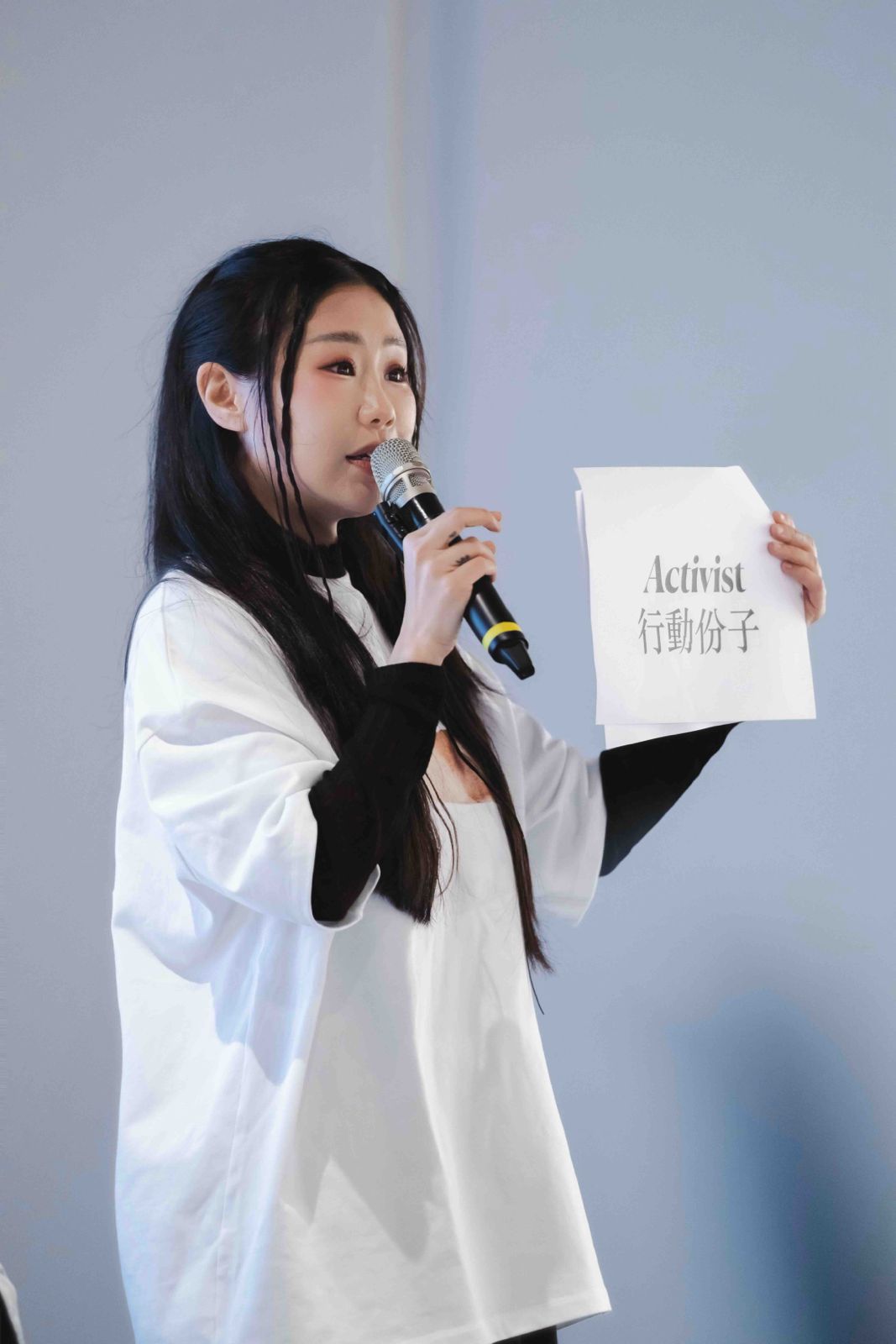
Wong Ka Ying
Hong Kong · b. 1990
Wong Ka Ying (b. 1990) is an artist, curator and writer based in Hong Kong. She is currently a PhD candidat in Cultural Studies at the Chinese University of Hong Kong. As a queer cultural worker, Wong’s interdisciplinary practice spans performance, multimedia, and writing. A keen observer of society, she critiques knowledge production within class and power structures. Her research interests is the subaltern, migrant worker communities, labour rights and gender politics.

Phoebe Man
Hong Kong
Phoebe Man is a multimedia artist, independent curator, and Associate Professor of the School of Creative Media at City University of Hong Kong. Her research focuses on women's art, art of social participation, and community art.

Sara Tse
Hong Kong
Sara Tse, based in Hong Kong, creates immersive environments using diverse media, including site-specific installations, ceramic sculptures, archival materials, drawings, and personal objects. Her work explores themes of nature, personal memories, natural history, cartography, domesticity, migration, and displacement. By weaving together seemingly unrelated aspects of daily life, she encourages audiences to reflect on the essence of belonging.

Shirley Tse
Shirley Tse, born in Hong Kong, is a California-based artist known for her sculptural work exploring place, politics, and ecology. She was the first woman to represent Hong Kong in a solo show at the Venice Biennale (2019). Her work has been exhibited internationally at venues including the Biennale of Sydney, MoMA PS1, and SFMOMA. Her artworks are held in major collections including M+ and the New Museum, New York. Tse has taught at CalArts over two decades and has received awards such as the Guggenheim Fellowship and the Anonymous Was A Woman Award.